Runtime Controls and Code Integrity Compared.
Compare Jscrambler's runtime third-party blocking, privacy controls, and code-integrity capabilities with CellWall's browser telemetry, policy enforcement, privacy, and compliance workflows.Secure your digital supply chain instantly.




An Active Client-Side Firewall.
SiteWall isn't just another passive scanner. It is a lightweight, zero-trust JavaScript sandbox that actively sits between your users and third-party vendors. It monitors the DOM in real-time, blocking unauthorized code execution and Magecart skimming attempts before data ever leaves the browser.

Zero-Trust Execution
Every script, regardless of origin, is monitored and sandboxed natively within the user's browser.
Automated Content Security Policies
Use observed browser activity to inform policy decisions. SiteWall does not claim automatic CSP deployment.
Vendor Agnostic & Frame-Agnostic
Whether it's an iframe, a Tag Manager injection, or an inline script, SiteWall intercepts and audits the execution flow.
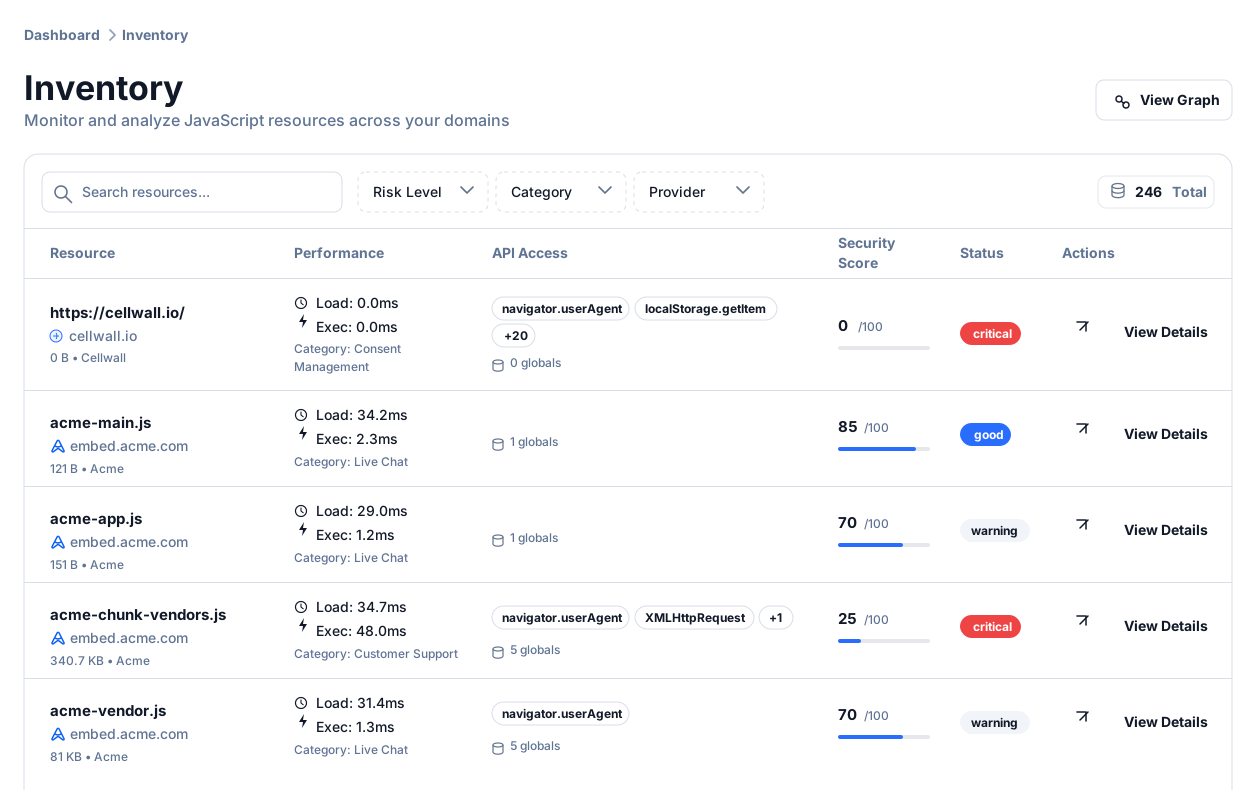

Real-Time Runtime Protection.
Visibility is not enough. SiteWall actively intercepts and neutralizes threats in the browser as they happen, stopping attacks before they can execute.

Exfiltration Blocking
Identify and autonomously block network requests attempting to drop sensitive user data to unauthorized or suspicious external endpoints.
DOM Tampering Prevention
Stop malicious scripts from injecting fake login forms, altering payment fields, or modifying critical page elements to steal user credentials.
Zero-Day Mitigation
Halt execution based on malicious behavior patterns, providing immediate protection before a CVE is even published.
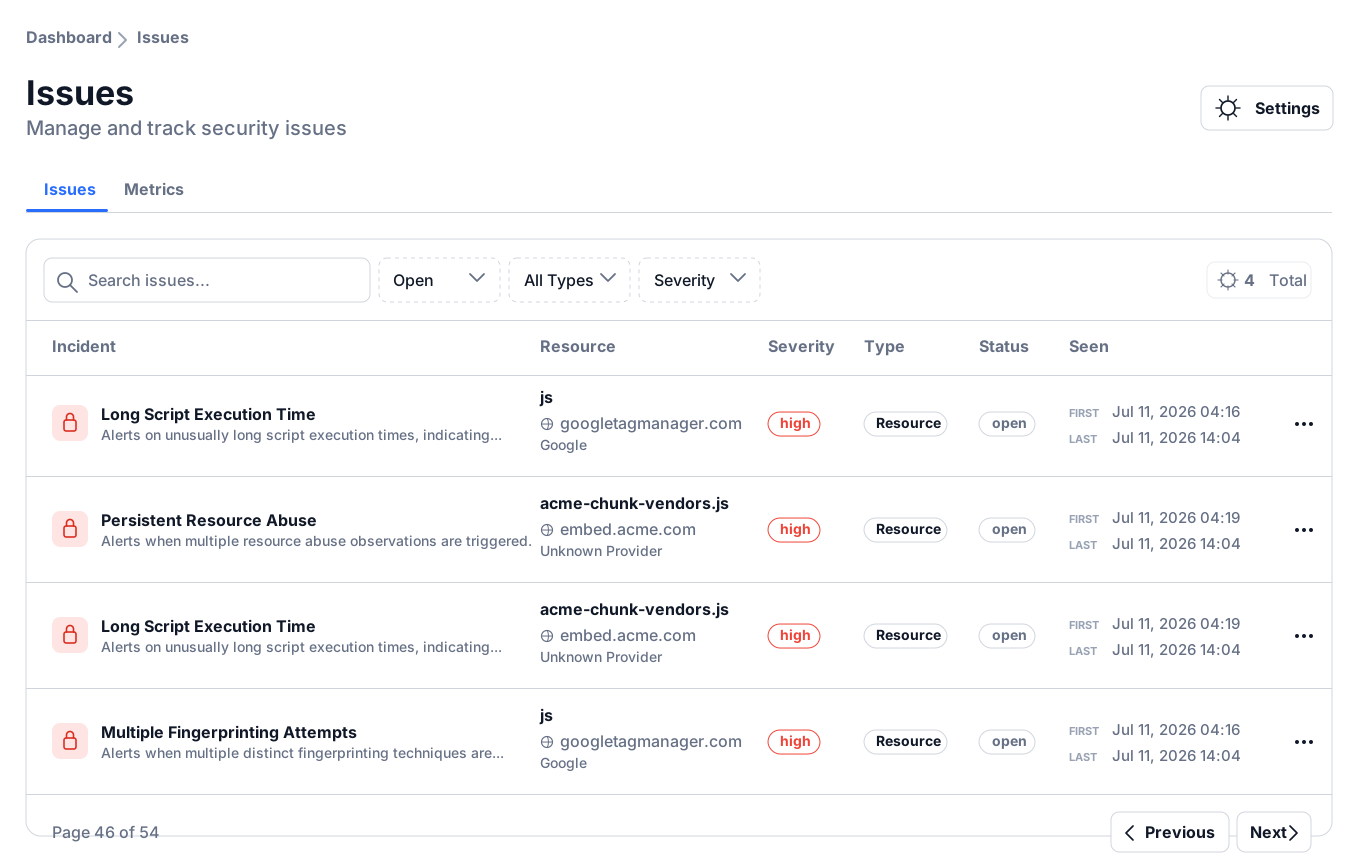
Issues and anomalies detection.
Stop chasing signatures and start monitoring behavior. SiteWall uses advanced heuristics to identify malicious intent the moment a script deviates from its established baseline.
Behavioral Heuristics
Automatically identify malicious patterns like form-grabbing, keylogging, and sensitive data scraping by monitoring DOM interactions in real-time.
Change Detection
Instantly detect and alert on unauthorized modifications to first-party or third-party scripts, ensuring code integrity across your entire application.
Execution Context Monitoring
Detect when a script attempts to run outside its expected sandbox, timeframe, or execution flow, neutralizing advanced evasion techniques.
Under the Hood
The Security Loop.
A continuous cycle of observation and active defense that keeps your digital supply chain secure.
Observe
Behavioral BaselineEvery script's execution path is mapped to establish a baseline of normal behavior.
Analyze
Threat IntelligenceReal-time analysis compares execution patterns against our global database of known attack vectors.
Intercept
Real-Time HookingMalicious network requests or sensitive DOM access are intercepted before execution.
Block
Policy EnforcementUnauthorized behavior is blocked instantly, and a forensic alert is dispatched to your dashboard.
LIVE PROTECTION
Monitor hidden behavior.
Not all threats load directly. SiteWall analyzes load flow chains to identify piggybacking—when an approved vendor silently loads unapproved third-party scripts.
FORENSIC TELEMETRY
Session-level security proof.
Security events include request and initiating-script context that can support investigations and audit evidence.
Choose your enforcement depth.
Jscrambler and CellWall offer different deployment and control models. Compare them against your runtime protection, code integrity, privacy, and operational requirements.

External AI Audit
Establish a security baseline with agentless, AI-driven periodic audits. Our crawlers simulate user behavior across your public-facing infrastructure to identify known vulnerabilities, expired certificates, and obvious supply chain risks without modifying a single line of your code.
Passive Observability
Gain high-fidelity, real-time insights with a non-blocking monitoring layer. By deploying a lightweight passive snippet, you receive instant alerts for script behavior deviations, unauthorized DOM access, and emerging threats as they happen in your users' browsers.
Active Enforcement
Apply configured controls to sensitive browser API calls and network destinations for scripts processed through SiteWall's enforcement mode.
Managed Script Proxy
Optionally process eligible cross-origin scripts through CellWall so configured API and network policies can be applied.
Expanded Enforcement
Extend enforcement coverage to more eligible scripts after testing policies and compatibility in your environment.
HOW WE COMPARE
SiteWall vs Jscrambler
Why modern security teams are upgrading from legacy tools to full-spectrum client-side shielding.
| Capability | Jscrambler | CellWall |
|---|---|---|
| Target Capabilities | Security & Obfuscation Only | Security + Privacy + Performance |
| Setup Complexity | High (Custom code & CI/CD integration) | Flexible (5 integration levels, from Snippet to Framework) |
| Policy response workflow | No (Manual Rules & Alert Triage) | Findings plus configurable controls |
| Cookie Consent & GDPR | No | Yes (Built-in CookieWall) |
| Pricing Transparency | Opaque, Expensive Annual Contracts | Transparent, Self-Serve Free Trial |

Security, Privacy, and Performance.
Jscrambler only focuses on code obfuscation and anti-tampering. CellWall provides complete visibility: we block Magecart, enforce GDPR cookie consent, and monitor third-party latency.
Alerting vs. Auto-Fixing.
Jscrambler advertises runtime third-party blocking, privacy controls, and code-integrity capabilities. CellWall provides browser telemetry and configurable API and network policies.
Flexible Integration vs. Rigid Build-Time Complexity.
Jscrambler forces heavy CI/CD pipeline integrations. CellWall adapts to your architecture with 5 flexible integration levels—ranging from a simple Tag Manager snippet to deep Next.js/React framework embedding.
DEEP DIVE COMPARISON
Why legacy security isn't enough for modern web applications.
Jscrambler focuses heavily on complex obfuscation and manual webpage integrity rules. Here is how CellWall provides a more agile, full-spectrum defense.
Runtime Shielding vs. Build-Time Obfuscation
Jscrambler's core strength is code obfuscation, which requires deep integration into your build pipeline (Webpack/Rollup). This slows down deployments and complicates debugging.
CellWall is purely runtime. It intercepts malicious behavior inside the browser without requiring you to alter your source code, obfuscate files, or change your CI/CD pipeline.
Policy response and alert triage
When Jscrambler detects an anomaly on a webpage, it fires an alert. Your security team must then investigate the log, determine the threat, and manually craft a patch or Content Security Policy.
CellWall connects findings to configurable browser API and network-destination policies. Review and test policy changes before enforcement.
Security Only vs. Full-Spectrum Governance
Jscrambler operates exclusively as a security tool. It provides zero visibility into whether your third-party scripts are violating user privacy laws (GDPR) or dragging down your core web vitals.
CellWall is an all-in-one platform. It actively enforces script security (SiteWall), user privacy and consent (CookieWall), and precise third-party performance latency.
FREQUENTLY ASKED QUESTIONS
Is SiteWall a replacement for a WAF?
No, SiteWall is a client-side security layer.
CellWall's Solution:A WAF protects server-side and edge traffic; SiteWall adds browser-side telemetry and controls as a complementary layer.
How exactly does SiteWall block Magecart?
Magecart scripts attempt to send captured form data (like credit cards) to an external drop-server.
CellWall's Solution:SiteWall actively intercepts these DOM interactions and detects unauthorized network requests to unknown domains, killing the connection before the data ever leaves the browser.
Does SiteWall help me meet PCI DSS 4.0 (Requirement 6.4.3 & 11.6.1)?
Yes. The new PCI DSS 4.0 mandates strict tracking and authorization of all payment page scripts.
CellWall's Solution:Script inventory, change observations, and exported evidence can support PCI DSS review. Your assessor determines compliance.
How is this different from just writing my own CSP (Content Security Policy)?
Manual CSPs are notoriously difficult to maintain and frequently break sites in production.
CellWall's Solution:SiteWall supplies browser telemetry and policy controls that can complement CSP. It does not claim automatic CSP deployment.
Will this conflict with Google Tag Manager (GTM) or my React/Next.js framework?
No, it integrates seamlessly into any modern stack without causing conflicts.
CellWall's Solution:SiteWall sits below your framework and Tag Manager. It observes their outputs natively without requiring you to change how your marketing team deploys tags or how your developers write code.
Secure your frontend in minutes.
Join the teams abandoning legacy obfuscation tools for full-spectrum, automated client-side protection.

Comparison information was reviewed against publicly available vendor materials and CellWall product documentation as of July 25, 2026. Features, packaging, and pricing may change. Please contact us if you notice an inaccuracy.