Embedded and Remote Monitoring Compared.
Compare CellWall's embedded browser telemetry and configurable runtime policies with Reflectiz's remote monitoring, simulated journeys, privacy workflows, and on-demand CSP blocking.Secure your digital supply chain instantly.




An Active Client-Side Firewall.
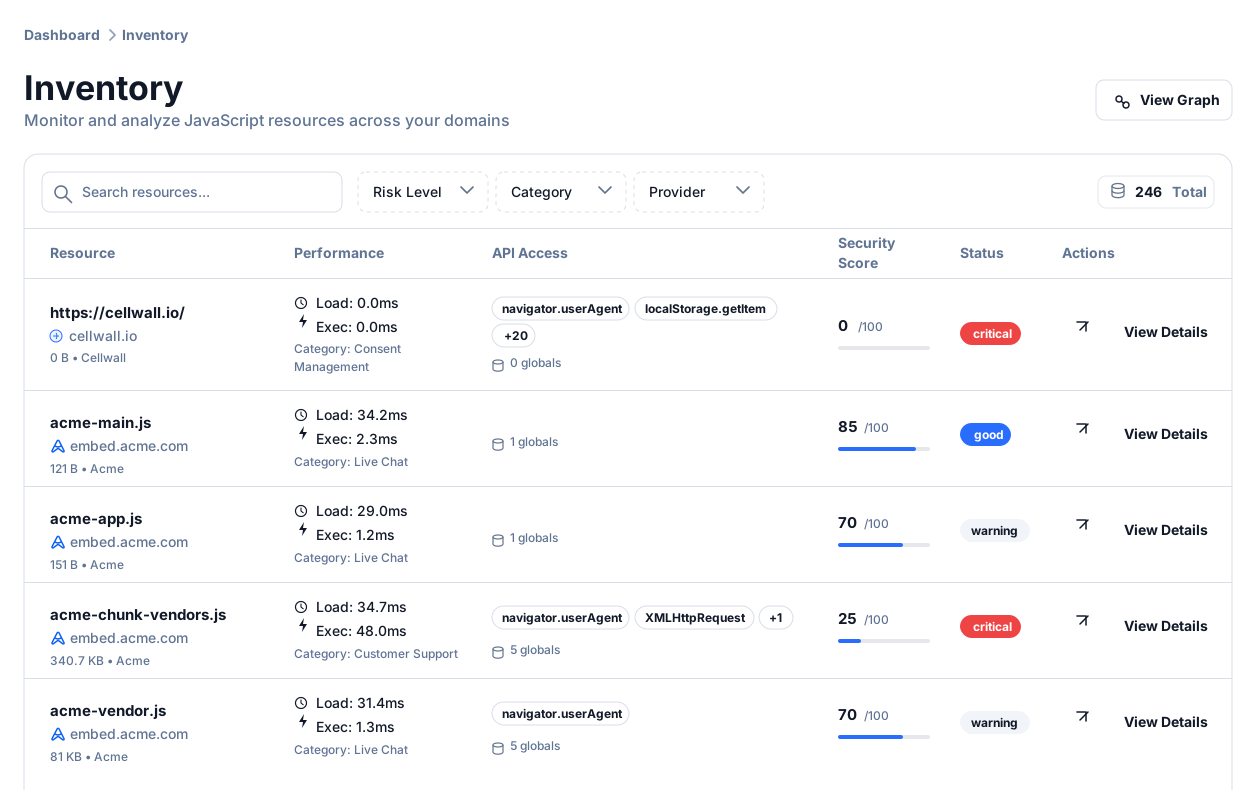
SiteWall isn't just another passive scanner. It is a lightweight, zero-trust JavaScript sandbox that actively sits between your users and third-party vendors. It monitors the DOM in real-time, blocking unauthorized code execution and Magecart skimming attempts before data ever leaves the browser.

Zero-Trust Execution
Every script, regardless of origin, is monitored and sandboxed natively within the user's browser.
Automated Content Security Policies
Use observed browser activity to inform policy decisions. SiteWall does not claim automatic CSP deployment.
Vendor Agnostic & Frame-Agnostic
Whether it's an iframe, a Tag Manager injection, or an inline script, SiteWall intercepts and audits the execution flow.

Real-Time Runtime Protection.
Visibility is not enough. SiteWall actively intercepts and neutralizes threats in the browser as they happen, stopping attacks before they can execute.

Exfiltration Blocking
Identify and autonomously block network requests attempting to drop sensitive user data to unauthorized or suspicious external endpoints.
DOM Tampering Prevention
Stop malicious scripts from injecting fake login forms, altering payment fields, or modifying critical page elements to steal user credentials.
Zero-Day Mitigation
Halt execution based on malicious behavior patterns, providing immediate protection before a CVE is even published.
Issues and anomalies detection.
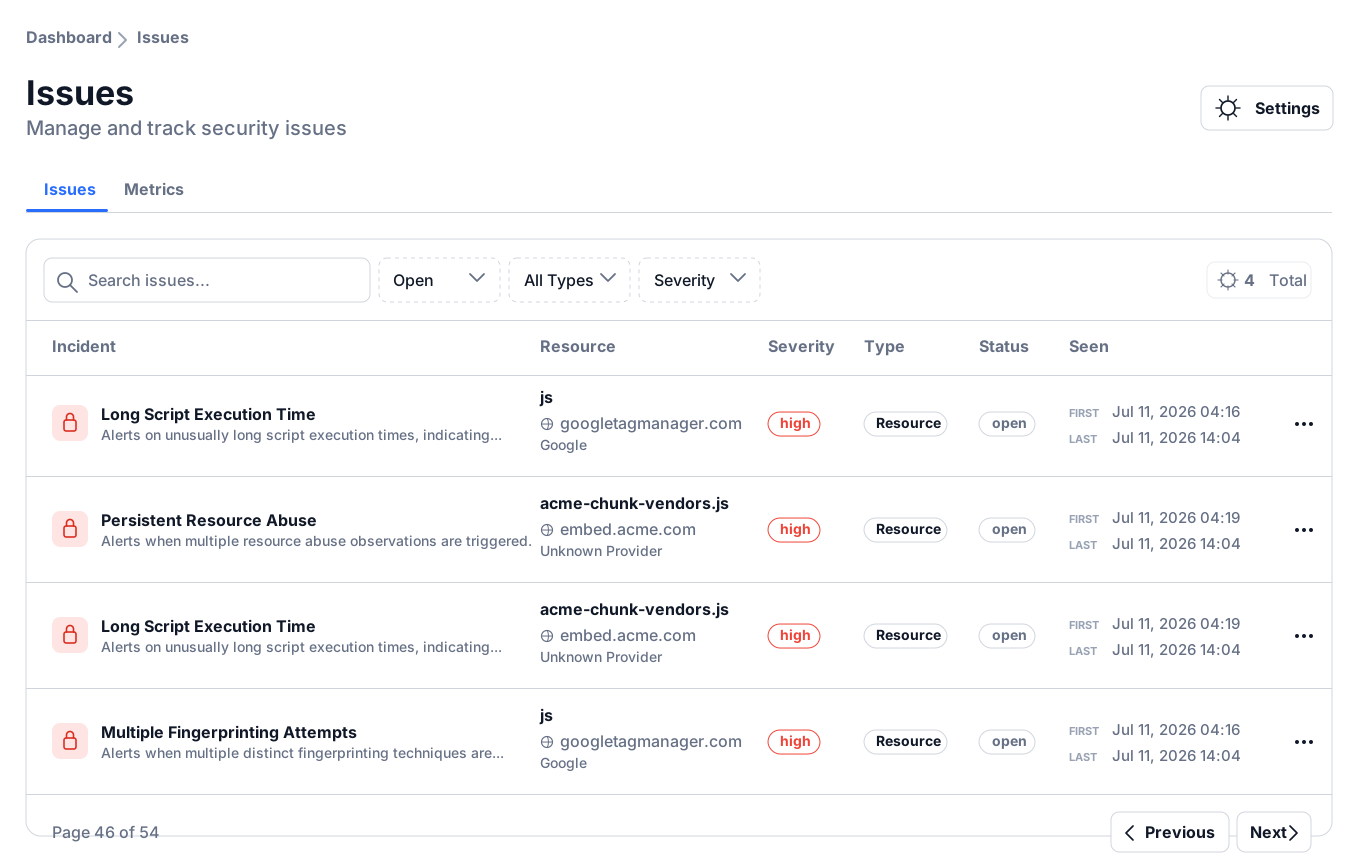
Stop chasing signatures and start monitoring behavior. SiteWall uses advanced heuristics to identify malicious intent the moment a script deviates from its established baseline.
Behavioral Heuristics
Automatically identify malicious patterns like form-grabbing, keylogging, and sensitive data scraping by monitoring DOM interactions in real-time.
Change Detection
Instantly detect and alert on unauthorized modifications to first-party or third-party scripts, ensuring code integrity across your entire application.
Execution Context Monitoring
Detect when a script attempts to run outside its expected sandbox, timeframe, or execution flow, neutralizing advanced evasion techniques.
Under the Hood
The Security Loop.
A continuous cycle of observation and active defense that keeps your digital supply chain secure.
Observe
Behavioral BaselineEvery script's execution path is mapped to establish a baseline of normal behavior.
Analyze
Threat IntelligenceReal-time analysis compares execution patterns against our global database of known attack vectors.
Intercept
Real-Time HookingMalicious network requests or sensitive DOM access are intercepted before execution.
Block
Policy EnforcementUnauthorized behavior is blocked instantly, and a forensic alert is dispatched to your dashboard.
LIVE PROTECTION
Monitor hidden behavior.
Not all threats load directly. SiteWall analyzes load flow chains to identify piggybacking—when an approved vendor silently loads unapproved third-party scripts.
FORENSIC TELEMETRY
Session-level security proof.
Security events include request and initiating-script context that can support investigations and audit evidence.

See what your actual users see.
Reflectiz uses remote monitoring and simulated journeys, including post-authentication monitoring. CellWall observes supported activity in instrumented browser sessions.
Don't just report. Fix it.
Reflectiz advertises on-demand CSP blocking. CellWall applies configured API and network-destination controls to scripts processed in enforcement mode.
Transparent, self-serve pricing.
Compare current plan scope and pricing directly with each vendor; Reflectiz publishes plan information and a free-trial path.
HOW WE COMPARE
SiteWall vs Reflectiz
Why modern security teams are upgrading to real-time client-side shielding.
| Capability | Reflectiz | CellWall |
|---|---|---|
| Real-time Runtime Monitoring | Remote monitoring and simulated journeys | Yes (Live user sessions) |
| Policy response workflow | No (Reporting & Guidance) | Findings plus configurable controls |
| Active Script Blocking | On-demand CSP blocking advertised | Yes (Built-in CSP & Sandbox) |
| Pricing Transparency | Opaque, Enterprise Sales Gate | Transparent, Self-Serve Free Trial |
| Setup Complexity | High (Requires vendor onboarding) | Low (Single JavaScript snippet) |
DEEP DIVE COMPARISON
Why a crawler isn't enough for modern web applications.
Reflectiz relies on an agentless, remote crawling approach. While easy to set up, it misses critical vulnerabilities. Here is how CellWall provides superior protection.
Interactive Threat Detection
Remote crawlers only scan static DOM elements. They cannot interact with user-specific states, logged-in sessions, or multi-step checkout forms where Magecart attacks typically trigger.
CellWall lives in the browser. We monitor active, live-user sessions and detect anomalous behavior the moment a user interacts with a form or payment field.
Remediation vs. Reporting
Reflectiz identifies vulnerabilities and generates alerts. Your engineering team is then responsible for deciphering the report, writing a CSP, and deploying a fix manually.
CellWall connects findings to configurable browser API and network-destination policies. It does not claim automatic CSP deployment.
Performance Impact Analysis
External crawlers cannot accurately measure the real-world latency and performance degradation that third-party scripts cause to your actual users' devices.
CellWall measures the exact execution time, network requests, and CPU footprint of every script on the end-user's device, giving you actionable performance metrics.
Blind Spots in Dynamic App States
Synthetic crawlers follow rigid, predefined paths. They completely miss scripts that only load under specific conditions—like localized geo-fencing, A/B testing variants, restricted user roles, or unique permission states.
CellWall executes natively in the browser. Because we monitor actual user sessions, our protection automatically scales to every possible app state, role, and A/B test variant without any configuration.
Fragile Setup & Constant Maintenance
To monitor complex flows like checkouts or authenticated portals, Reflectiz requires you to manually program and maintain synthetic user journeys. If your UI changes, the crawler breaks, leaving you unprotected until it's fixed.
CellWall's embedded snippet observes supported activity in real browser sessions without requiring synthetic journey definitions; coverage still depends on instrumentation and configured policies.
FREQUENTLY ASKED QUESTIONS
Will CellWall slow down my website?
Security solutions shouldn't compromise performance. Unlike heavy proxy-based solutions or bloated tracking scripts, we prioritize speed.
CellWall's Solution:The current production snippet is under 25 KB when compressed and loads asynchronously. Validate its impact against your own pages and performance budget.
How difficult is it to migrate from Reflectiz to CellWall?
Switching security vendors often involves complex architecture changes, but our approach is designed to be plug-and-play.
CellWall's Solution:Deployment starts by adding the CellWall snippet directly or through a tag manager. Actual migration time depends on testing, policy scope, and your release process.
Do you offer a free trial?
Enterprise security tools often require opaque pricing and lengthy sales calls just to see the product in action.
CellWall's Solution:Yes. We offer a transparent, self-serve 14-day free trial. You can create an account, deploy the snippet, and see the value immediately without entering a credit card.
Does SiteWall help me meet PCI DSS 4.0 (Requirement 6.4.3 & 11.6.1)?
Yes. The new PCI DSS 4.0 mandates strict tracking and authorization of all payment page scripts.
CellWall's Solution:Script inventory, change observations, and exported evidence can support PCI DSS review. Your assessor determines compliance.
Will this conflict with Google Tag Manager (GTM) or my React/Next.js framework?
No, it integrates seamlessly into any modern stack without causing conflicts.
CellWall's Solution:SiteWall sits below your framework and Tag Manager. It observes their outputs natively without requiring you to change how your marketing team deploys tags or how your developers write code.
Is SiteWall a replacement for a WAF?
No, SiteWall is a client-side security layer.
CellWall's Solution:A WAF protects server-side and edge traffic; SiteWall adds browser-side telemetry and controls as a complementary layer.
How exactly does SiteWall block Magecart?
Magecart scripts attempt to send captured form data (like credit cards) to an external drop-server.
CellWall's Solution:SiteWall actively intercepts these DOM interactions and detects unauthorized network requests to unknown domains, killing the connection before the data ever leaves the browser.
Can SiteWall detect 'Piggybacking' scripts?
Yes. Approved third-party scripts often load their own unvetted dependencies ('Shadow IT').
CellWall's Solution:Our load-flow analysis traces the entire dependency chain, allowing you to instantly identify and block 'shadow' scripts loaded silently by your approved vendors.
How is this different from just writing my own CSP (Content Security Policy)?
Manual CSPs are notoriously difficult to maintain and frequently break sites in production.
CellWall's Solution:SiteWall supplies browser telemetry and policy controls that can complement CSP. It does not claim automatic CSP deployment.
Secure your frontend in minutes.
Join the teams abandoning legacy crawler tools for real-time, automated client-side protection.

Comparison information was reviewed against publicly available vendor materials and CellWall product documentation as of July 25, 2026. Features, packaging, and pricing may change. Please contact us if you notice an inaccuracy.