Two Browser-Side Security Approaches.
cside states that it uses a browser snippet rather than a reverse proxy, CDN, or DNS change. CellWall also uses browser-side instrumentation and adds scheduled discovery, privacy workflows, and configurable runtime policies.Secure your digital supply chain instantly.




An Active Client-Side Firewall.
SiteWall uses a lightweight JavaScript snippet. It monitors supported DOM activity in real time. Its zero-trust sandbox can restrict supported actions for eligible scripts processed in enforcement mode, helping protect users by blocking unauthorized code execution and Magecart skimming attempts before data ever leaves the browser.

Zero-Trust Execution
Every script, regardless of origin, is monitored and sandboxed natively within the user's browser.
Automated Content Security Policies
Use observed browser activity to inform policy decisions. SiteWall does not claim automatic CSP deployment.
Vendor Agnostic & Frame-Agnostic
Whether it's an iframe, a Tag Manager injection, or an inline script, SiteWall intercepts and audits the execution flow.
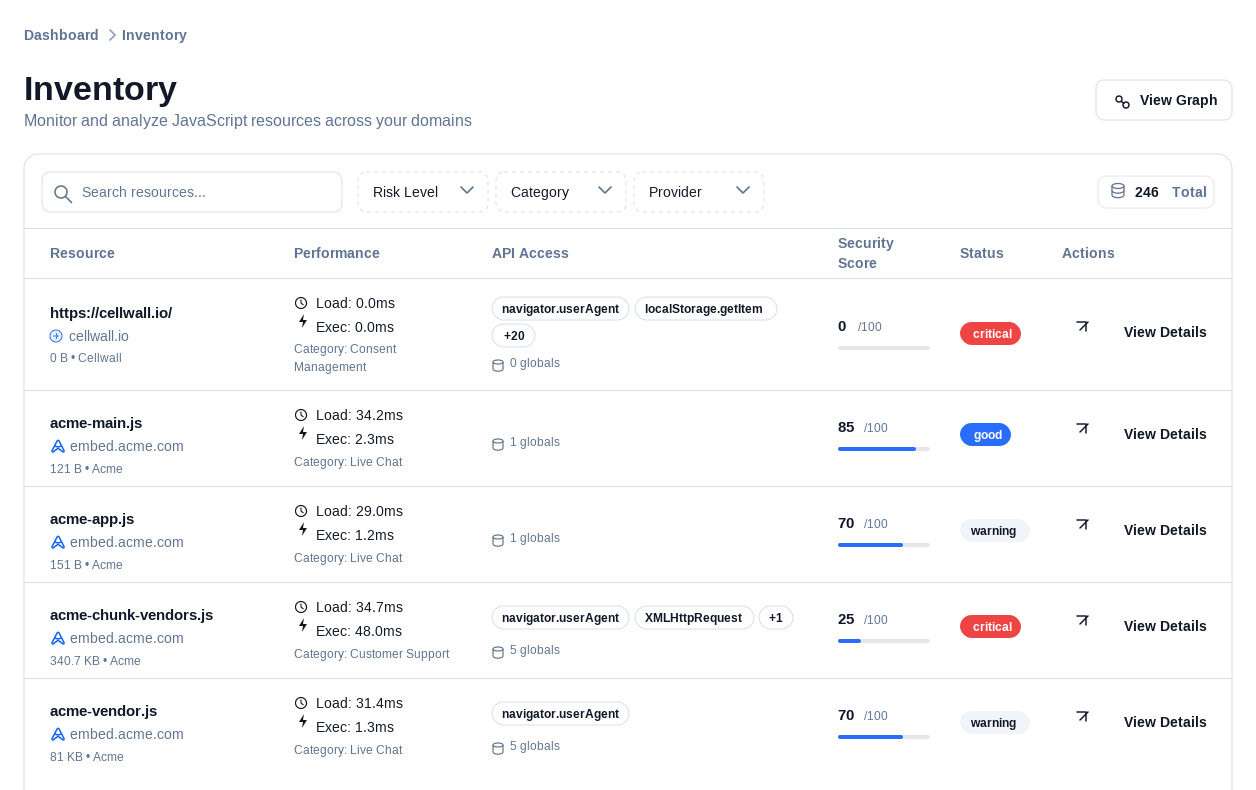

Real-Time Runtime Protection.
Visibility is not enough. SiteWall actively intercepts and neutralizes threats in the browser as they happen, stopping attacks before they can execute.

Exfiltration Blocking
Identify and autonomously block network requests attempting to drop sensitive user data to unauthorized or suspicious external endpoints.
DOM Tampering Prevention
Stop malicious scripts from injecting fake login forms, altering payment fields, or modifying critical page elements to steal user credentials.
Zero-Day Mitigation
Halt execution based on malicious behavior patterns, providing immediate protection before a CVE is even published.
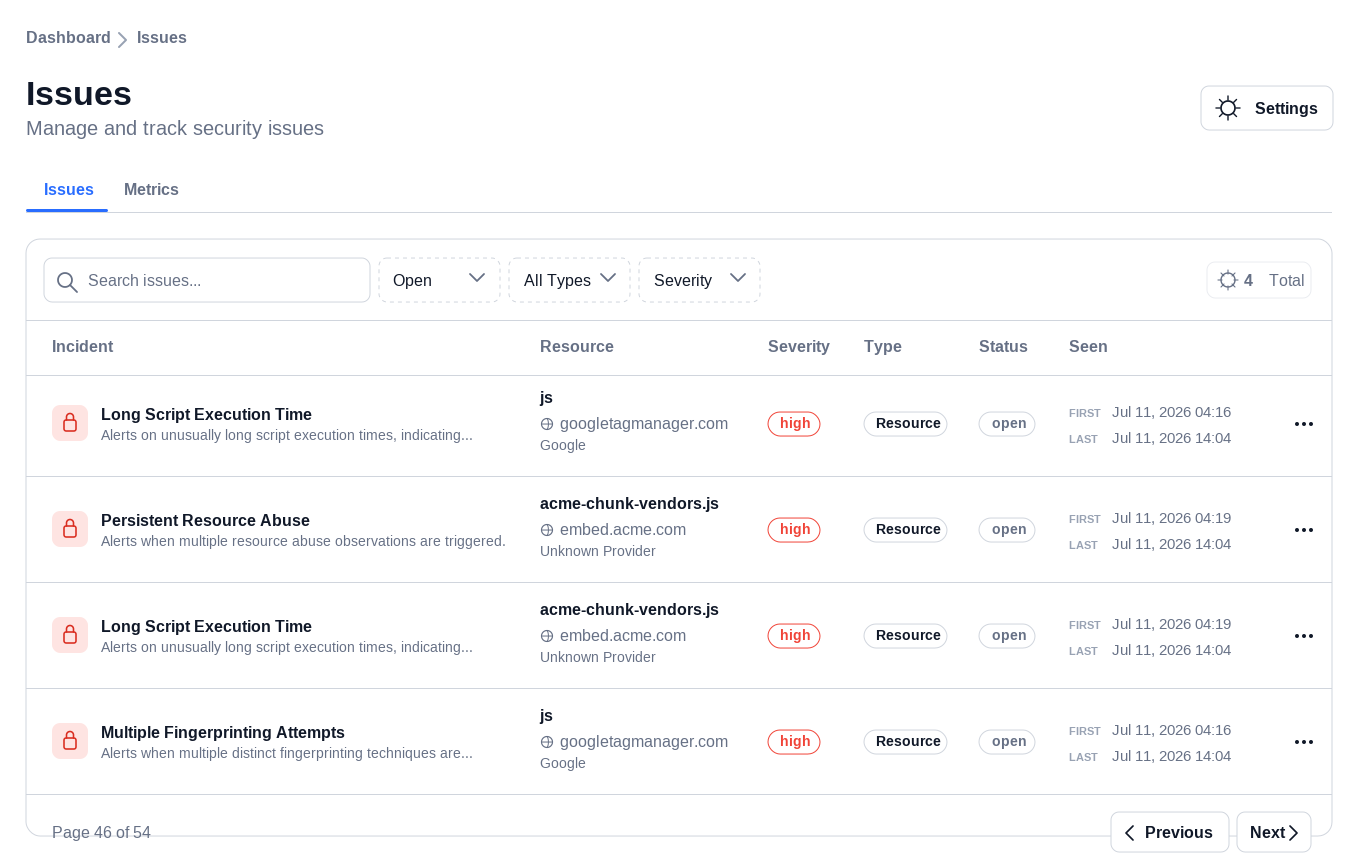
Issues and anomalies detection.
Stop chasing signatures and start monitoring behavior. SiteWall uses advanced heuristics to identify malicious intent the moment a script deviates from its established baseline.
Behavioral Heuristics
Automatically identify malicious patterns like form-grabbing, keylogging, and sensitive data scraping by monitoring DOM interactions in real-time.
Change Detection
Instantly detect and alert on unauthorized modifications to first-party or third-party scripts, ensuring code integrity across your entire application.
Execution Context Monitoring
Detect when a script attempts to run outside its expected sandbox, timeframe, or execution flow, neutralizing advanced evasion techniques.
Under the Hood
The Security Loop.
A continuous cycle of observation and active defense that keeps your digital supply chain secure.
Observe
Behavioral BaselineEvery script's execution path is mapped to establish a baseline of normal behavior.
Analyze
Threat IntelligenceReal-time analysis compares execution patterns against our global database of known attack vectors.
Intercept
Real-Time HookingMalicious network requests or sensitive DOM access are intercepted before execution.
Block
Policy EnforcementUnauthorized behavior is blocked instantly, and a forensic alert is dispatched to your dashboard.
LIVE PROTECTION
Monitor hidden behavior.
Not all threats load directly. SiteWall analyzes load flow chains to identify piggybacking—when an approved vendor silently loads unapproved third-party scripts.
FORENSIC TELEMETRY
Session-level security proof.
Security events include request and initiating-script context that can support investigations and audit evidence.
Choose your deployment path.
Both products advertise snippet-based deployment. SiteWall supports scheduled browser audits, browser observability, and script enforcement.

Scheduled Browser Audit
Establish a security baseline with scheduled browser audits. The audit browser exercises configured pages and journeys without installing a snippet for website visitors.
Browser Observability
Gain real-time insights with a lightweight snippet in your users' browsers. SiteWall evaluates observed behavior for alerts, and configured consent checks can intervene.
Active Enforcement
Apply configured controls to sensitive browser API calls and network destinations for scripts processed through SiteWall's enforcement mode.
Script Processing Setup
Optionally process eligible cross-origin scripts through CellWall so configured API and network policies can be applied.
Expanded Enforcement
Extend enforcement coverage to more eligible scripts after testing policies and compatibility in your environment.
HOW WE COMPARE
SiteWall vs cside.dev
Why development teams prefer native execution over proxy routing.
| Capability | cside.dev | CellWall |
|---|---|---|
| Architecture | Reverse Proxy (Added Latency) | Native browser monitoring |
| Remediation Approach | LLM Explanations | Policy findings and configurable controls |
| Setup Complexity | Moderate (Requires DNS/Routing changes) | Flexible (Tailored to your stack and needs) |
| Cookie Consent & GDPR | No | Yes (Built-in CookieWall) |
| Pricing & Trial | Free Tier available | Transparent, Self-Serve Free Trial |

Zero Architectural Complexity.
cside.dev offers a browser-based Script Method and a separate Scan Method. CellWall executes natively in the browser via a lightweight snippet. Measure the effect of your chosen deployment on Core Web Vitals.
Action vs. Explanation.
cside.dev focuses on LLMs explaining what a script does. CellWall focuses on action—instantly generating the exact CSP rule to block threats with one click.
Full-Spectrum Governance.
Don't just secure scripts. CellWall provides full-spectrum governance, combining Magecart protection, strict GDPR Cookie Consent, and third-party performance tracking.
DEEP DIVE COMPARISON
Why proxy-based security creates bottlenecks.
cside.dev protects web applications using a browser snippet or a separate Scan Method. Here is how CellWall's native execution compares.
Native Execution vs Proxy Latency
Routing traffic through a third-party reverse proxy inherently adds network latency. For high-performance ecommerce or SaaS applications, every millisecond impacts Core Web Vitals.
CellWall executes directly inside the browser using a JavaScript snippet.
Automated Action vs Explanatory Intelligence
cside.dev focuses heavily on using AI to explain what a script does. While helpful, it still requires your engineering team to interpret the AI output and write the blocking rules.
CellWall connects findings to configurable browser API and network-destination policies. Review and test policy changes before enforcement.
Full-Spectrum Governance
cside.dev focuses almost exclusively on security. It does not provide comprehensive tools for enforcing user privacy (GDPR/CCPA) or auditing the exact performance impact of third-party vendors.
CellWall provides an integrated suite: SiteWall for security, CookieWall for consent enforcement, and detailed latency metrics to govern your entire digital supply chain.
FREQUENTLY ASKED QUESTIONS
Is SiteWall a replacement for a WAF?
No, SiteWall is a client-side security layer.
CellWall's Solution:A WAF protects server-side and edge traffic; SiteWall adds browser-side telemetry and controls as a complementary layer.
How exactly does SiteWall block Magecart?
Magecart scripts attempt to send captured form data (like credit cards) to an external drop-server.
CellWall's Solution:SiteWall actively intercepts these DOM interactions and detects unauthorized network requests to unknown domains, killing the connection before the data ever leaves the browser.
Does SiteWall help me meet PCI DSS 4.0 (Requirement 6.4.3 & 11.6.1)?
Yes. The new PCI DSS 4.0 mandates strict tracking and authorization of all payment page scripts.
CellWall's Solution:Script inventory, change observations, and exported evidence can support PCI DSS review. Your assessor determines compliance.
How is this different from just writing my own CSP (Content Security Policy)?
Manual CSPs are notoriously difficult to maintain and frequently break sites in production.
CellWall's Solution:SiteWall supplies browser telemetry and policy controls that can complement CSP. It does not claim automatic CSP deployment.
Will this conflict with Google Tag Manager (GTM) or my React/Next.js framework?
No, it integrates seamlessly into any modern stack without causing conflicts.
CellWall's Solution:SiteWall sits below your framework and Tag Manager. It observes their outputs natively without requiring you to change how your marketing team deploys tags or how your developers write code.
Secure your frontend natively.
Explore native, configurable client-side protection.

Comparison information was reviewed against publicly available vendor materials and CellWall product documentation as of July 25, 2026. Features, packaging, and pricing may change. Please contact us if you notice an inaccuracy.