
01
Identify the resource and its access.
Connect a script to observed form, DOM, storage, profile, device, or network capabilities supported by browser telemetry.
SENSITIVE-DATA EXFILTRATION PREVENTION
Connect observed access to forms, storage, and browser capabilities with the outbound destinations used by each script, then investigate and constrain routes that do not match their purpose.

CONTROL THE CLIENT-SIDE EGRESS PATH
Sensitive-data exfiltration prevention for websites is the practice of observing how browser code accesses supported data surfaces, mapping the destinations it contacts, and applying reviewed controls to unexpected routes. It reduces exposure in the client-side layer while complementing server, endpoint, identity, privacy, and secure-development controls.
Connect a script to observed form, DOM, storage, profile, device, or network capabilities supported by browser telemetry.
Separate reviewed destinations from newly observed domains, regions, and request paths that require context.
Review business purpose and affected behavior before allowing, restricting, or blocking a route, resource, or provider.
ACCESS-TO-EGRESS CORRELATION
A script touching a browser surface is not automatically harmful, and a new destination is not automatically an exfiltration endpoint. The useful signal is the relationship between the resource, the access it exercised, the request it initiated, and the destination it reached.
See which supported browser surfaces and APIs a resource used before or around an outbound request.
Compare the contacted domain or region with the reviewed behavior expected for that resource and provider.
Bring the resource, access, destination, session, and policy state together instead of reviewing isolated events.
Browser access
SCOPED NETWORK CONTROL
Translate a reviewed data-flow expectation into a technical boundary. Define allowed regions or domains, inherit a common baseline, and narrow the policy for a provider or resource whose purpose justifies a more specific route.
Limit supported outbound communication to destinations reviewed for the resource's documented purpose.
Apply an allowed network region when geography is a relevant part of the technical data-flow decision.
Use inherited policy for common behavior and targeted overrides when a narrower decision is justified.
FROM ROUTE CHANGE TO REVIEW
A vendor release, analytics configuration, consent change, or application deployment can produce unfamiliar browser behavior. Review the affected resource, provider history, sessions, destination, capabilities, timing, and policy state before classifying the event.
Compare first-seen activity and recent behavior with releases, tag changes, and known provider updates.
Determine where the behavior was observed without assuming every page, session, visitor, or data category was affected.
Keep findings, the current policy decision, latest disposition, and technical context available for follow-up or routing into existing workflows.
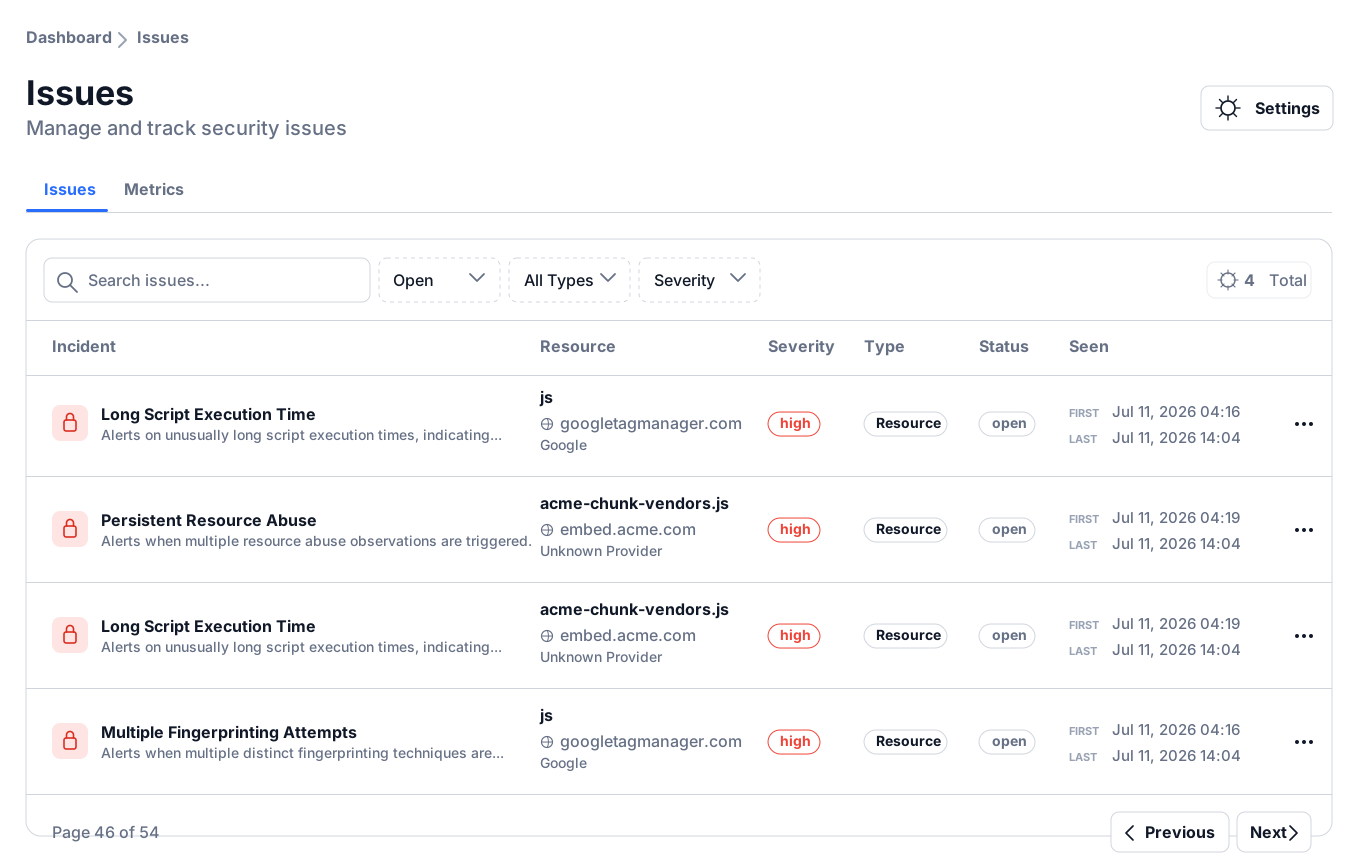
A PRACTICAL EGRESS-CONTROL LOOP
The workflow keeps technical evidence and ownership together while allowing legitimate browser integrations to continue operating.
Inventory resources and record the supported browser capabilities, data surfaces, and destinations observed during normal operation.
Identify a new destination, capability, resource, or provider relationship that no longer matches the reviewed baseline.
Use the available evidence to allow the route, restrict its destination, or block the responsible resource or provider.
Keep the technical observation, affected context, current policy decision, and latest disposition available for future review.
SHARED CONTEXT, DIFFERENT DECISIONS
Sensitive-data exposure crosses security, privacy, and web operations. A shared record keeps each discipline involved without collapsing their responsibilities into one tool.
Investigate unexpected access and destinations, assess attacker and supply-chain hypotheses, and select scoped technical containment.
Compare observed browser routes with data maps, purposes, vendor records, consent state, retention decisions, and legal analysis.
Validate legitimate releases, identify the responsible dependency, test policy changes, and protect application availability.
Go deeper into the controls, evidence, and related use cases behind this workflow.
Review resource, provider, capability, and network controls for supported browser activity.
Investigate observed scope and evaluate a bounded browser policy response.
Compare captured visitor choices with observed browser behavior.
See how browser discovery, investigation, policy control, and supporting evidence work together.
SENSITIVE-DATA EXFILTRATION FAQ
Understand what the browser layer can reveal, where configured controls apply, and which responsibilities remain with the wider security and privacy program.
It is the unauthorized movement of data from a web page or browser-accessible surface to an external destination through client-side code or browser requests.
Browser-side support:Browser observations can connect supported access behavior, the responsible resource, and outbound destinations for investigation and policy review.
Relevant signals can include newly observed scripts, unexpected form or storage access, unfamiliar browser capabilities, changed request behavior, and new network destinations.
Browser-side support:Correlation provides stronger investigation context than treating any single event as proof of data loss.
No. Coverage depends on the telemetry, application architecture, deployment mode, supported APIs, and controls available for the affected script and request.
Browser-side support:Use observed access and destination metadata as technical context alongside application knowledge, data classification, and other security evidence.
Yes. A trusted service can change behavior, load another dependency, be misconfigured, or become compromised, but an unfamiliar action is not automatically malicious.
Browser-side support:Provider, resource, dependency, capability, destination, and history context helps reviewers assess the specific change.
Configured network policies can restrict supported destinations, and resource or provider policies can block supported code processed through enforcement mode.
Browser-side support:Apply the narrowest control supported by the evidence, test it against application behavior, and preserve a recovery path.
Treat a new destination as a review event rather than an automatic incident. Confirm the owner, purpose, release, data-flow expectation, and operational impact.
Browser-side support:The resulting decision can update the reviewed policy and preserve why the route was accepted or restricted.
No. Those controls address different layers. Browser policy does not govern endpoints, email, cloud storage, databases, servers, source repositories, or every network path.
Browser-side support:Use it as a focused layer for browser-executed resources, supported access behavior, and outbound website destinations.
Connect supported data access to destinations, investigate meaningful change, and apply reviewed boundaries without losing the operational context behind them.