
01
Establish the expected state.
Record the visitor's available categories and captured choice, then define which website behavior is expected before and after that choice.
WEBSITE PRIVACY AND CONSENT ASSURANCE
Review captured consent decisions alongside the identifiers, tags, browser activity, and destinations observed in the relevant session—then investigate possible differences from the expected configuration.

FROM RECORDED CHOICE TO OBSERVED BEHAVIOR
Website privacy and consent assurance is the technical practice of reviewing a captured visitor choice alongside the browser behavior observed afterward. Consent events, identifiers, resources, capabilities, and destinations provide context that teams can use to investigate whether the delivered experience matches the expected configuration.
Record the visitor's available categories and captured choice, then define which website behavior is expected before and after that choice.
Monitor supported identifier writes, resource loading, browser capabilities, and outbound destinations in the relevant website and session context.
Connect unexpected activity to the responsible resource, route the context through the organization's workflow, update configuration where appropriate, and repeat the browser review.
CONSENT-STATE VERIFICATION
A banner interaction is only the start of assurance. The operational question is whether the delivered website reflects that state: which identifiers appear, which resources activate, what capabilities they use, and where they communicate before and after the choice.
See which supported identifiers, resources, and requests appear before a visitor records an optional consent choice.
Relate the captured category state to the website behavior observed afterward instead of treating the banner event as sufficient evidence.
Identify the script, provider, destination, timing, and session context associated with activity that needs review.
CONSENT DRIFT AND CONFIGURATION REVIEW
Consent behavior can drift when a tag-manager rule changes, a vendor adds a dependency, a regional configuration diverges, or an application release changes loading order. Keep the observed signal connected to the website context and the team able to correct it.
Connect activity to the tag, script, provider, and dependency that initiated it instead of diagnosing from a cookie name alone.
Retain the page, consent state, timing, location context, and affected session used to reproduce the behavior.
Repeat the browser review after a configuration change and record the formal outcome in the organization's privacy or change-management workflow.
PRIVACY REVIEW EVIDENCE
Privacy teams can use captured consent events, identifier and destination context, findings, and available session observations as technical input to reviews maintained through their existing privacy and change-management workflows.
Retain when a resource, identifier, capability, or destination was first and last observed in the relevant consent context.
Use the finding, resource context, current disposition, and relevant team information in the organization's privacy workflow.
Use relevant consent events, session observations, resource context, and findings in internal privacy reviews, vendor conversations, audits, and remediation follow-up.
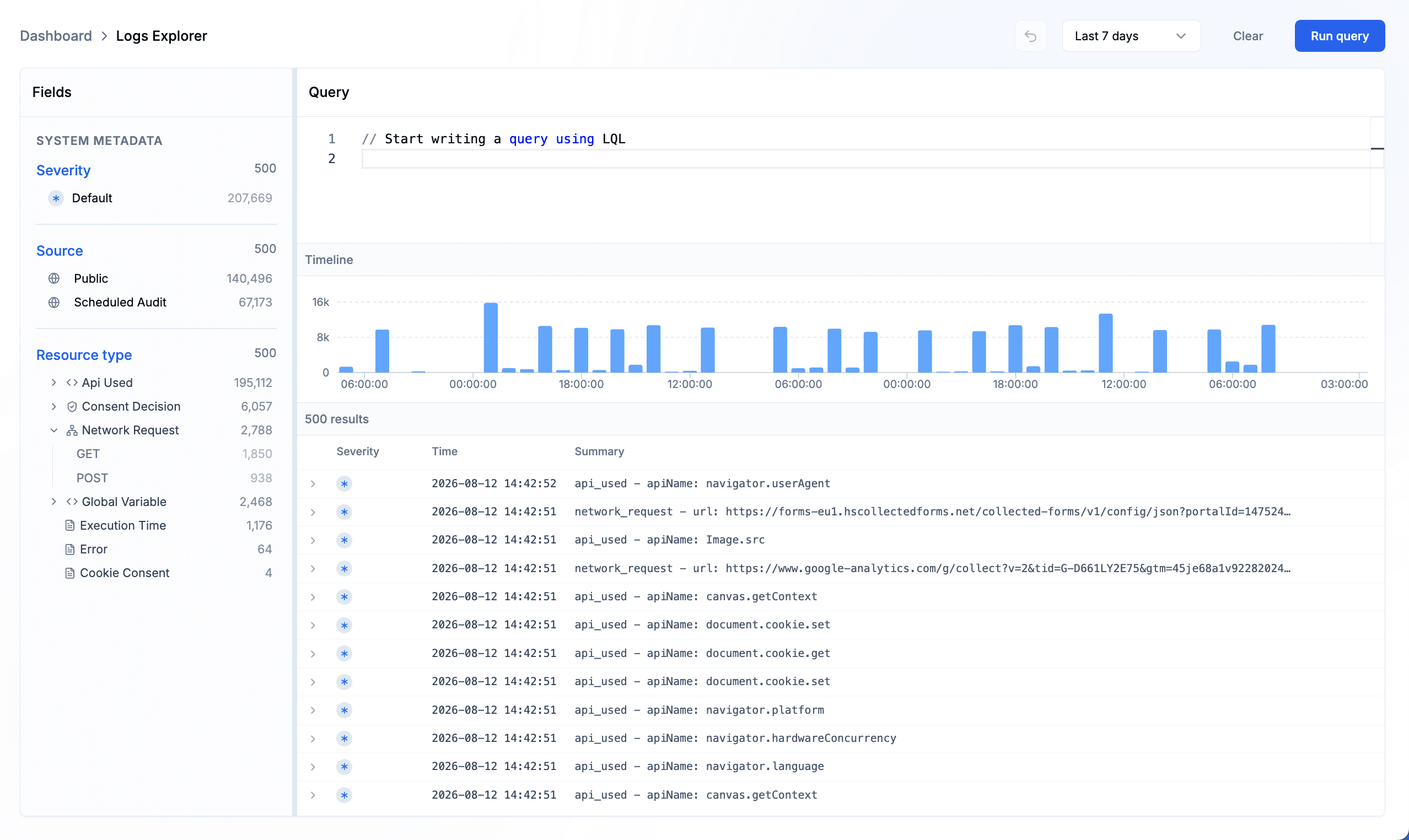
A REPEATABLE CONSENT-ASSURANCE LOOP
The operating loop keeps visitor choice, browser behavior, and remediation evidence connected as tags, vendors, releases, and regional experiences change.
Specify the available categories, captured choice, relevant website context, and the resources or behavior expected for each state.
Record supported identifiers, resources, capabilities, and destinations before and after the consent choice in representative sessions.
Trace the discrepancy to the resource, provider, configuration, dependency, timing, and owner that can explain or correct it.
Repeat the browser observation after remediation and record the resulting decision through the organization's privacy or change-management process.
ONE CONSENT STATE, SHARED RESPONSIBILITY
The browser record creates a common technical foundation while preserving the distinct judgment and ownership of each team.
Define purposes and consent expectations, interpret regulatory obligations, review vendors and data uses, and decide whether observed behavior requires legal or policy action.
Validate trigger rules, loading order, regional configuration, consent signals, vendor integrations, and the application changes needed to align behavior.
Investigate unexpected resources, capabilities, destinations, and supply-chain changes that may create wider privacy or data-exposure risk.
Go deeper into the controls, evidence, and related use cases behind this workflow.
Use browser-side observations as supporting technical context for privacy reviews.
Inspect captured resource behavior and session context behind a signal.
Review resource, provider, capability, and network controls for supported browser activity.
See how browser discovery, investigation, policy control, and supporting evidence work together.
WEBSITE CONSENT ASSURANCE FAQ
Understand what browser observation can verify, what requires legal interpretation, and how consent assurance fits into a wider privacy program.
It is the technical practice of reviewing a captured visitor choice alongside supported identifiers, resources, capabilities, and destinations observed in the relevant website session.
Technical assurance:That context helps teams investigate possible differences from the expected consent configuration and decide what to verify or correct.
No. A consent-management system presents choices, stores signals, and coordinates configuration. Browser assurance reviews the captured choice alongside supported runtime observations.
Technical assurance:Use the consent event and browser context together to investigate whether implementation matches the expected state.
Supported browser observations can reveal identifiers, resources, capabilities, and requests that appear before an optional consent choice is recorded.
Technical assurance:The responsible script, provider, page, timing, and session context can then be reviewed against the organization's expected behavior.
No. Coverage depends on deployment, browser behavior, supported telemetry, application architecture, session conditions, encryption, and the technique used.
Technical assurance:Combine continuous observation with representative scenario testing, data mapping, vendor review, and other privacy controls.
Browser behavior can be compared across captured consent states to review whether supported tags, requests, and identifiers activate as expected.
Technical assurance:Implementation owners should also validate platform-specific configuration, signal propagation, regional defaults, and vendor documentation.
Configured resource, provider, capability, and network policies can constrain supported code and requests processed through enforcement mode.
Technical assurance:Review purpose and operational impact, test the narrowest useful control, and retain a recovery path before production enforcement.
Consent behavior can vary by jurisdiction, language, device, login state, page type, experiment, or tag configuration, so one session is not a universal result.
Technical assurance:Define representative scenarios and use the captured context from each observation in the organization's testing and review records.
Review consent state alongside observed browser behavior, investigate meaningful differences, and bring current technical context into the next privacy review.