
Own What Happens in the Browser: Introducing SiteWall
By CellWall Team | Published August 9, 2026 | Product Updates | 5 min read
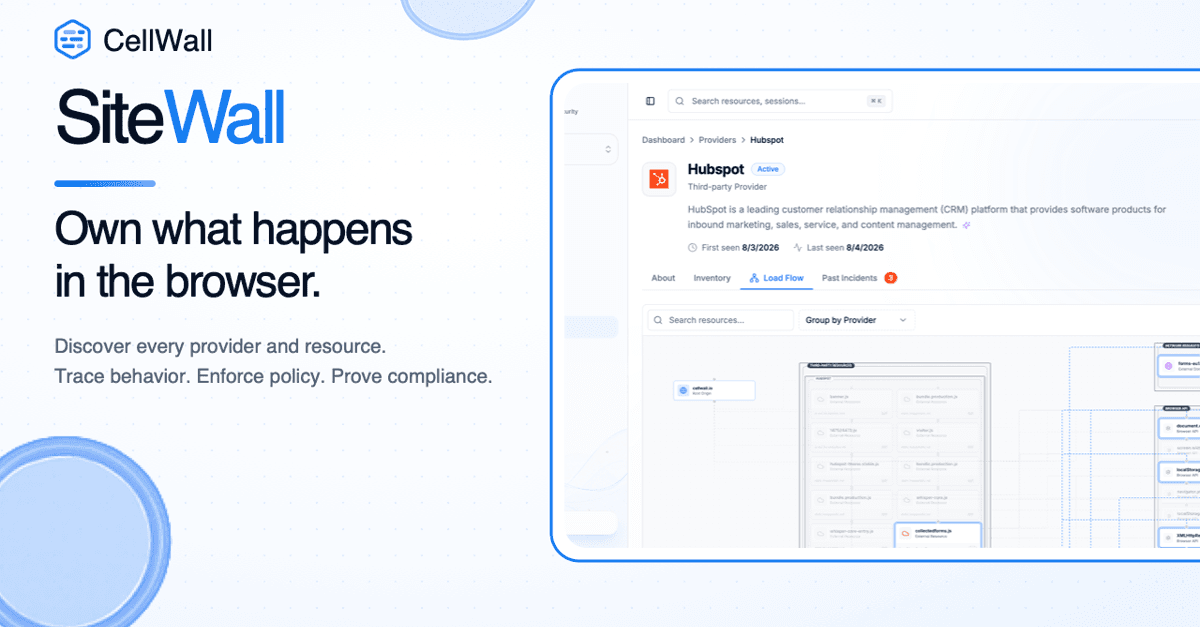

Your production stack does not stop at the server. Once a page reaches a visitor, analytics, chat, consent, payment, marketing, and other third-party services continue operating inside the browser—often with access to sensitive APIs, storage, and network destinations.
SiteWall makes that client-side runtime layer visible. It gives security, engineering, and compliance teams a shared view of what is present, what it does, what changed, and which controls should apply—without replacing the platforms they already use.
The browser-side visibility gap
Traditional controls provide strong visibility into infrastructure, applications, and server-side events. But the final execution environment belongs to the visitor's browser. Third-party resources can load other resources, call browser APIs, transmit data, change over time, or affect page performance after deployment checks are complete.
A provider approved last month may serve different code today. SiteWall observes the resource actually delivered to the browser, so teams can evaluate real behavior instead of relying only on an integration name or a static inventory.
Discover every provider and resource
SiteWall builds a living inventory for client-side attack-surface management. Providers are connected to the individual resources they deliver, with activity, loading relationships, performance, API access, risk signals, and historical context available from one place.
Understand what is present
Identify direct and indirectly loaded third-party providers.
Inspect each provider's resources, activity, and past incidents.
Trace load flows from the page to external resources, domains, and browser APIs.
Understand what changed
Detect newly observed resources and behavioral anomalies.
Review issues with the affected resource and session context.
Measure load and execution impact before it becomes a user-facing problem.
Control every layer
Visibility becomes useful when it leads to a precise decision. SiteWall supports third-party script governance through zero-trust defaults for newly discovered resources, geographic restrictions, network policies, provider-level decisions, and granular access to browser capabilities.
Set the default
Apply a zero-trust posture to newly discovered resources so unknown code cannot silently expand the client-side attack surface.
Derive permissions from observed use
Use detected resource behavior to establish the browser capabilities a resource actually needs, then remove unnecessary access.
Constrain communication
Restrict network regions and destinations to reduce unauthorized communication and data-exfiltration paths.
Respond proportionately
If a third party is compromised or begins affecting site reliability, block the provider while the team investigates and restores confidence.
Turn runtime signals into evidence
SiteWall maps continuous browser observations to the requirements that teams must operate and demonstrate. Readiness, actions, and evidence are broken down by requirement, giving compliance owners a clear route from a finding to its remediation and supporting record.
| Framework | SiteWall evidence |
|---|---|
PCI DSS v4.0.1 | Payment-page script inventory, authorization, integrity monitoring, and change detection, with report export for supporting evidence. |
GDPR | Evidence for data minimization, third-party processing visibility, privacy-by-default controls, and processing records. |
ISO/IEC 27001:2022 | Client-side asset inventory, supplier risk context, incident signals, and configuration-integrity evidence. |
When it is time to share progress with an auditor or stakeholder, teams can generate an exportable report directly from the relevant framework view. The result is an audit-ready package grounded in observed runtime activity—not a point-in-time spreadsheet assembled from memory.
Fits the way your teams already work
SiteWall is designed to extend existing security and engineering operations. Integrations route browser-side signals into the workflows your team already monitors, helping the right people investigate and respond without creating another isolated queue.
"The goal is not another dashboard. It is a shared operating model for discovering, controlling, and proving what happens on your website."
SiteWall questions and answers
What is SiteWall?
SiteWall is CellWall's client-side security platform. It continuously discovers browser resources and third-party providers, observes their behavior, applies security policies, and turns runtime activity into compliance evidence.
What does SiteWall monitor in the browser?
SiteWall monitors providers, JavaScript resources, loading relationships, browser API use, network destinations, performance, behavioral anomalies, issues, and historical activity in the website visitor's browser.
Can SiteWall derive permissions from observed resource use?
Yes. SiteWall uses observed behavior to help derive the browser capabilities a resource needs, enabling teams to remove unnecessary permissions and apply more granular policies.
Which compliance frameworks does SiteWall support?
SiteWall provides browser-side evidence and workflows for GDPR, ISO/IEC 27001:2022, and PCI DSS v4.0.1. Requirements, actions, readiness, and supporting evidence are organized by framework and requirement.
Can SiteWall block a third-party provider?
Yes. Teams can use SiteWall policies to block a provider when it is compromised, behaves unexpectedly, or begins affecting website reliability while the issue is investigated.
Does SiteWall replace existing security and engineering tools?
No. SiteWall is designed to extend existing workflows by routing browser-side findings and alerts into the platforms teams already use.
Ready to own what happens in the browser?
See how SiteWall can reveal your client-side attack surface, enforce precise policy, and turn continuous runtime activity into evidence.

Continue exploring
Continue exploring
Read the practical guides that clarify the surrounding risks, controls, and evidence.
Explore the client-side security hub
Client-Side Security
What Is Client-Side Security? Risks, Attacks, and Best Practices
Learn what client-side security protects, how browser attacks work, why third-party JavaScript creates risk, and which controls secure modern web applications.

Client-Side Security
Third-Party JavaScript Monitoring: Uptime, Updates, and Behavioral Drift
Learn how to monitor third-party script availability, performance, update frequency, dependency changes, and unexpected behavior in the browser.
Client-Side Security
Why Your Website Changes in the Browser
See how third-party scripts reshape a page after delivery, what client-side security observes, and how teams control browser-side risk.